
T: +86-512-86871686
P: +86-13814898700
P: +86-13814898700
No.639 Yuanxin Road, Taoyuan Town, Wujiang, Suzhou, Jiangsu, China
Views: 0 Author: Site Editor Publish Time: 2026-07-21 Origin: Site
Modern apparel and technical textiles rely heavily on precise stretch and recovery metrics. Yarn failure at the consumer level almost always originates on the production line. Sourcing substandard stretch materials introduces severe operational risks for textile mills and garment manufacturers. Mid-production breakage, poor dye uptake, and sudden loss of elasticity usually stem from a lack of visibility into the supplier's manufacturing processes. Understanding the exact manufacturing and covering processes of ELASTIC YARN is mandatory for procurement managers and textile engineers. This technical knowledge allows teams to properly evaluate suppliers, mitigate production risks, and ensure end-product viability. Without a firm grasp of extrusion methods and covering mechanics, buyers risk procuring materials that fail under the mechanical stress of high-speed knitting or high-temperature dyeing.
The production method (dry spinning, wet spinning, or melt extrusion) directly dictates the base elastomer's thermal stability, chemical resistance, and stretch modulus.
Bare elastomers are rarely used alone; the creation of spandex covered yarn through air-covering or mechanical covering is essential for durability, abrasion resistance, and dyeability.
Evaluating a supplier requires analyzing specific technical data sheets (TDS) for draft ratio, denier consistency, oil pick-up (OPU) percentage, and elongation-to-break metrics.
Balancing cost and performance requires aligning the specific yarn construction (core-spun vs. air-covered vs. double-covered) with the mechanical stress requirements of the final textile.
End-use applications dictate the required modulus of elasticity and tensile strength. High-compression medical wear requires high power and strict modulus tolerances to exert precise pressure on the human body. These garments demand elastomers that maintain consistent compression profiles over extended periods. Lightweight hosiery demands low-denier elastomers that provide gentle stretch without compromising sheer aesthetics. Baseline performance metrics include stretch percentage, recovery rate, and resistance to fatigue. Elastic recovery measures the material's ability to return to its original length after deformation. Fatigue resistance ensures the garment survives hundreds of stretch-and-recovery cycles during daily wear and laundering. When evaluating materials, engineers must look at the hysteresis curve, which plots the energy lost during the stretch and recovery cycle. A tight hysteresis curve indicates a high-quality elastomer that will not bag or sag after repeated use.
Yarn uniformity prevents machine jams, needle wear, and tension variations during high-speed knitting and weaving. Inconsistent diameter or elasticity causes fabric defects like barre or banding, which often only become visible after dyeing. Friction coefficients play a critical role in runnability. Manufacturers apply specialized finishes, known as coning oil or lubricants, during yarn production. The standard requirement is a 2% to 4% Oil Pick-Up (OPU). This precise lubrication layer provides anti-static properties and ensures smooth feed-out performance across guides and needles. If the OPU is too low, friction increases, leading to filament breakage and machine downtime. If the OPU is too high, the excess oil can interfere with dye uptake and cause uneven coloration in the final fabric. Mill operators must constantly monitor tension meters during the knitting process to ensure the elastomer feeds at a consistent rate.
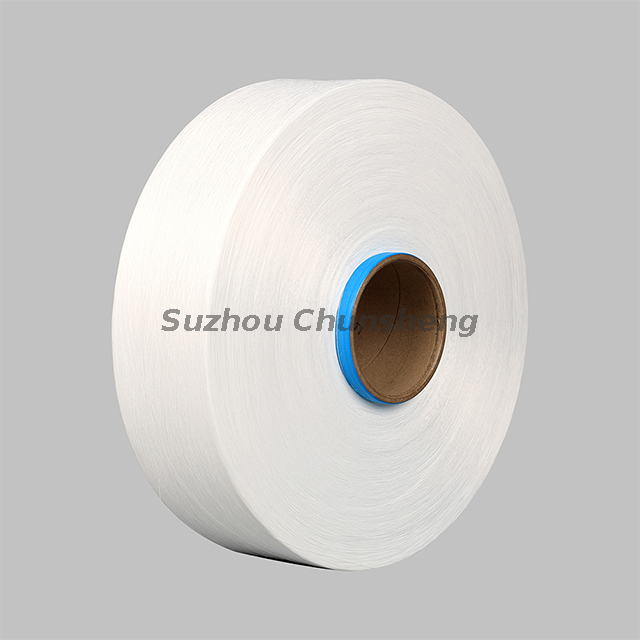
Dry spinning accounts for over 80% of commercial spandex production. The process begins with the chemical prepolymerization of polyurethane, reacting a macroglycol with a diisocyanate to create the polymer chain. Extrusion involves pumping this viscous polymer through a spinneret into a heated nitrogen gas column. The heat evaporates solvents, primarily dimethylacetamide (DMAC), solidifying the liquid into continuous filaments. This method offers the optimal balance of mechanical recovery, durability, and heat resistance. The precise control of the nitrogen gas temperature and flow rate determines the final filament's cross-sectional shape and surface characteristics. Dry-spun filaments typically exhibit a dog-bone or peanut-shaped cross-section, which provides excellent cohesion when bundled together to form a multi-filament yarn.
Wet spinning extrudes the polymer directly into a chemical coagulation bath. The bath solidifies the filaments by drawing the solvent out of the polymer stream. This method operates at slower production speeds and serves niche applications requiring specific chemical properties. Melt extrusion involves melting thermoplastic polyurethane chips without chemical solvents. The molten polymer is forced through a spinneret and cooled in a quenching chamber. This process provides significant environmental advantages by eliminating solvent handling and recovery systems. However, melt-spun elastomers exhibit lower thermal degradation thresholds and reduced elastic recovery compared to dry-spun alternatives. They are generally reserved for lower-end applications where extreme heat resistance is not required during downstream processing.
The molecular structure of the elastic core consists of alternating soft and hard segments. Polyether or polyester glycols form the soft segments, providing the stretch capability. Diisocyanates and chain extenders form the hard segments, providing crystalline strength and heat resistance. The ratio and distribution of these segments determine the yarn's physical properties. Polyether-based spandex offers superior resistance to hydrolysis and microbial degradation, making it ideal for swimwear and activewear exposed to sweat and moisture. Polyester-based spandex provides superior UV stability and oil resistance, suiting outerwear and industrial applications. Understanding this chemical matrix is essential when selecting materials for specific end-use environments.
Bare elastomers lack the durability and surface characteristics required for direct textile integration. Creating spandex covered yarn solves this problem by protecting the core and enhancing processing capabilities. The covering process dictates the final yarn's hand-feel, dyeability, and mechanical behavior.
| Covering Method | Process Description | Primary Applications | Production Speed |
|---|---|---|---|
| Single-Covered (SCY) | One layer of outer yarn wrapped in a single direction. | Lightweight fabrics, basic hosiery. | Moderate (15,000 RPM) |
| Double-Covered (DCY) | Two layers wrapped in opposite directions (S and Z twist). | Medical compression, premium activewear. | Slow (10,000 RPM) |
| Air-Covered (ACY) | Compressed air knots outer filament around the core. | Standard activewear, seamless garments. | Fast (800+ m/min) |
| Core-Spun | Staple fibers twisted around the core during spinning. | Stretch denim, woven shirting. | Moderate |
Mechanical covering physically wraps a rigid staple or filament yarn around a pre-stretched elastic core. Single-Covered Yarn (SCY) wraps one layer of cover yarn in a single direction. Manufacturers use SCY for lightweight fabrics. The single-direction wrap creates residual torque, causing the yarn to twist. This torque must be managed during knitting to prevent fabric skewing. Double-Covered Yarn (DCY) wraps two layers of cover yarn in opposite directions, known as S-twist and Z-twist. This dual-layer construction neutralizes torque, providing superior balance and durability. Premium activewear and medical hosiery rely on DCY because it completely encapsulates the core, preventing it from breaking under extreme stress.
Air-covering uses high-pressure compressed air inside an intermingled jet. The air blows and knots the outer filament around the elastic core at specific intervals. Air-covered yarn (ACY) serves as a highly cost-effective, high-production-speed alternative to mechanical covering. ACY provides a distinctive tactile loft and soft hand-feel. The frequency and strength of the intermingling knots determine the yarn's stability. If the knots are too far apart, the core can slip during knitting, causing defects. Technicians must calibrate the air pressure and overfeed ratios to achieve the desired knot count and stability.
Core-spinning integrates the elastic filament directly into the spinning frame. Ring spinning or open-end spinning machines twist staple fibers, such as cotton, wool, or rayon, around the tensioned elastic core. This method produces natural-touch, high-recovery woven fabrics like stretch denim and shirting. The core must be perfectly centered within the staple fiber sheath. If the core wanders to the surface, it will not dye properly, resulting in a defect known as grinning. Maintaining precise tension control on the roving and the elastomer is critical during core-spinning.
Nylon-covered spandex delivers superior abrasion resistance and a softer hand-feel. It dominates intimate apparel and premium activewear. Nylon accepts acid dyes, which produce vibrant, deep colors. Polyester-covered spandex provides higher UV resistance, superior chlorine resistance, faster drying times, and greater cost efficiency. It dominates swimwear and budget-conscious sportswear. Polyester requires disperse dyes and high-temperature dyeing processes. The choice between nylon and polyester dictates the entire downstream finishing process and the final garment's performance characteristics.
Draft ratio defines the degree of stretch applied to the elastic core during the covering process. This ratio directly impacts the final fabric's modulus, power, and compression profile. Higher draft ratios yield stiffer, higher-compression fabrics. Evaluating denier consistency across yarn packages prevents grinning. Grinning occurs when the un-dyed, bare elastic core slips and becomes visible through the outer cover yarn, ruining the fabric's appearance. Quality control teams use capacitance testing to measure denier uniformity and identify thick or thin spots in the yarn before it reaches the knitting floor.
The manufacturing process dictates the yarn's ability to withstand high-temperature finishing. Critical heat-setting temperature thresholds typically range from 180°C to 190°C. Exceeding these thresholds causes thermal degradation, crystallizing the hard segments and destroying the elasticity. Heat-setting stabilizes the fabric's dimensions and prevents shrinkage during consumer laundering. Dye uptake presents another challenge. Acid dyes target nylon-covered yarn, while disperse dyes target polyester-covered yarn. Matching the chemical affinity prevents color-matching and shading failures. Dyehouse managers must carefully control the heating and cooling rates to prevent the elastomer from losing its recovery properties during the dye cycle.
Dry spinning requires rigorous environmental management. Closed-loop solvent recovery systems capture and reuse DMAC, minimizing ecological impact. Supplier certifications verify safe chemical management. Look for OEKO-TEX Standard 100 for harmful substance testing, Global Recycled Standard for recycled polyester/nylon sheaths, and REACH compliance for the European market. Auditing a supplier's solvent recovery efficiency provides insight into their operational maturity and commitment to sustainable manufacturing practices.
Mechanical double-covering operates at slower spindle speeds, typically 10,000 to 20,000 RPM. This process demands high energy consumption, driving up manufacturing costs. Air-covering offers rapid throughput, reaching speeds up to 1,000 meters per minute, significantly lowering costs. Absorb the premium cost of double-covered yarn for applications demanding extreme structural integrity, such as medical compression hosiery or high-end swimwear. Utilize air-covered yarn for standard activewear and fast fashion where extreme durability is less critical.
Environmental factors severely impact stored elastomers. UV light, ozone exposure, high humidity, and temperatures exceeding 30°C accelerate degradation. Improper storage causes yellowing and breaks down the polyurethane core. This degradation leads to unexpected core tension drops and high breakage rates during downstream processing. Strict climate control in storage facilities is mandatory. Yarn packages should remain sealed in UV-blocking plastic until immediately before use. Implement a strict first-in, first-out (FIFO) inventory system to prevent shelf-life expiration.
Yarn breakage during circular knitting or weaving stems from inconsistent draft ratios, uneven lubricant application, or poor knotting and splicing. Testing for residual thermal shrinkage in both the core elastomer and the cover yarn is critical. Conduct these tests before committing to bulk dyehouse processing to prevent dimensional instability in the final fabric.
Measure the initial length of a yarn sample under standard tension.
Subject the sample to boiling water or hot air at the expected dyehouse temperature for 30 minutes.
Allow the sample to cool and condition in a standard atmosphere for 24 hours.
Remeasure the length and calculate the percentage of shrinkage.
Adjust knitting machine settings to compensate for the calculated shrinkage.
Vetting suppliers requires a strict technical checklist. Request Technical Data Sheets (TDS), certificates of analysis (COA) per batch, and testing laboratory reports. Specify testing standards such as ASTM D2731 for elastic properties and ISO 2062 for single-end breaking force and elongation at break. Request physical trial cones. Conduct tension testing and run-ability analysis on your specific machinery before finalizing procurement contracts. Evaluate the supplier's packaging quality to ensure the yarn is protected from physical damage and environmental exposure during transit.
Request comprehensive technical specification sheets (TDS) from potential suppliers to verify draft ratios and OPU percentages.
Order sample cones to conduct high-speed knitting or weaving trials on your production floor before bulk ordering.
Verify environmental and solvent-recovery certifications to ensure long-term compliance and supply chain stability.
Test residual thermal shrinkage in a laboratory setting before authorizing bulk fabric dyeing.
Implement strict climate-controlled storage protocols to prevent UV and thermal degradation of the elastomer core.
A: It is a composite textile material where a bare elastomeric core is wrapped or entangled with a rigid outer filament, such as nylon or polyester. This covering protects the core, improves dyeability, and enhances abrasion resistance.
A: Dry spinning uses chemical solvents evaporated by heat to form filaments, offering superior stretch recovery and heat resistance. Melt extrusion melts thermoplastic chips without solvents, which is more eco-friendly but yields lower thermal stability.
A: The ideal draft ratio depends on the required compression, but typically ranges between 2.5 and 3.5 for activewear. This provides a balance of supportive power and comfortable stretch.
A: Breakage usually results from uneven oil pick-up (OPU), inconsistent draft ratios, or degradation of the polyurethane core due to improper storage conditions like high heat or UV exposure.
A: Grinning is prevented by ensuring tight denier uniformity, optimizing the covering process to fully encapsulate the core, and matching the dye affinity of the outer sheath to the fabric requirements.