
T: +86-512-86871686
P: +86-13814898700
P: +86-13814898700
No.639 Yuanxin Road, Taoyuan Town, Wujiang, Suzhou, Jiangsu, China
Views: 0 Author: Site Editor Publish Time: 2026-09-23 Origin: Site
Modern sportswear and medical textiles are expected to do much more than simply cover the body. Sportswear needs to manage heat, moisture, odor, and repeated movement, while medical textiles often require better hygiene, comfort, durability, and specialized performance. These requirements have increased the demand for FUNCTIONAL YARN, which is engineered to provide specific properties beyond those of conventional textile yarns.
From antibacterial yarn and cooling yarn to functional polyester yarn, different yarn technologies can be selected according to the end-use environment. For sportswear manufacturers, the right yarn can improve thermal comfort and freshness during physical activity. For medical textile producers, functional yarns can help support hygiene and long-term wearing comfort.
This article explains the major types of functional yarn used in sportswear and medical textile applications and the factors manufacturers should consider when choosing the right material.
Functional yarn is a type of textile yarn developed with additional physical or chemical properties for a specific application. These functions may be introduced through functional additives, modified polymers, specialized spinning processes, functional masterbatch, or engineered fiber structures.
Unlike ordinary yarn, FUNCTIONAL YARN is selected not only according to denier, strength, elongation, color, and texture, but also according to the performance expected from the finished fabric.
Common functional properties include:
Antibacterial performance
Cooling and thermal regulation
Moisture management
Heat retention
Flame resistance
Odor control
UV protection
Enhanced durability
Polyester is particularly suitable for many functional textile applications because its properties can be modified during yarn production. As a result, functional polyester yarn is widely used in activewear, uniforms, medical fabrics, socks, underwear, and technical textiles.
Sportswear is repeatedly exposed to sweat, heat, friction, stretching, and frequent washing. Conventional yarn may provide adequate strength and appearance, but specialized sportswear yarn can add functions that improve the user's experience.
For example, athletes and consumers increasingly look for clothing that feels cooler during exercise, dries efficiently, remains fresh after prolonged use, and retains its functional performance after repeated wear.
This makes functional yarn suitable for products such as:
Running shirts
Training wear
Yoga clothing
Gym wear
Sports socks
Cycling apparel
Outdoor clothing
Performance underwear
Depending on the garment design, several functional yarn technologies may also be combined within the same fabric.
Antibacterial yarn is one of the most important functional yarn categories for applications where hygiene and odor management are critical.
Antibacterial properties can be introduced into yarn through antibacterial additives, functional masterbatch, or fibers specifically engineered to inhibit microbial growth.
In sportswear, sweat and warm conditions can create an environment favorable to bacterial growth. Antibacterial sportswear yarn can therefore be useful in garments that remain in direct contact with the skin for long periods.
Typical applications include sports socks, activewear, underwear, running clothing and fitness apparel.
Antibacterial functionality is also relevant to medical textile yarn. Medical fabrics may be used in healthcare environments where cleanliness and hygiene are especially important. Depending on product specifications and applicable standards, antibacterial yarn can be considered for medical fabrics, bandages, dressings and related textile products.
Suzhou Chunsheng provides Antibacterial Yarn in polyester POY, FDY and DTY specifications. Different antibacterial systems can be selected according to the intended textile application.
The main advantages include improved textile hygiene, reduced bacterial growth, better odor control and greater suitability for garments that experience frequent contact with sweat or skin.
For manufacturers, antibacterial yarn also provides a way to add a clear functional selling point to activewear and specialized textile products.
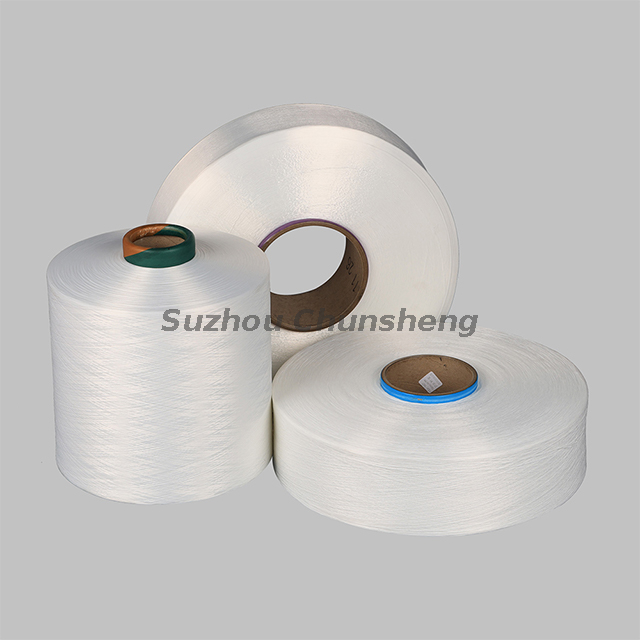
Thermal comfort is another major requirement in sports clothing. During exercise, the body produces heat, and clothing that traps excessive heat can reduce comfort.
Cooling yarn is designed to provide a cooler wearing sensation or support better heat management in the fabric.
Depending on the yarn technology, cooling effects can be achieved through functional mineral components, thermal-conductive additives, yarn cross-section design, moisture transfer characteristics, or combinations of these mechanisms.
Cooling functional yarn is particularly useful in:
Summer sportswear
Running clothing
Cycling jerseys
Yoga wear
Lightweight training apparel
Sports underwear
Outdoor clothing
For brands targeting warm climates or summer collections, cooling yarn can provide a distinct performance advantage.
It is important, however, to distinguish between an initial cool-touch sensation and long-term thermal management. Buyers should therefore evaluate yarn specifications according to the required fabric performance rather than relying only on the term "cooling."
Polyester remains one of the most widely used fiber materials in performance clothing because it combines good mechanical performance, processing versatility and suitability for functional modification.
A functional polyester yarn may incorporate antibacterial, cooling, warming, flame-retardant or other properties while maintaining the processing advantages associated with polyester yarn.
Different spinning forms can also be selected according to fabric construction.
POY is commonly used as an intermediate yarn for further processing. FDY provides continuous filaments with relatively stable dimensional characteristics, while DTY offers textured characteristics that can improve bulk, elasticity and fabric hand.
The appropriate yarn structure depends on whether the manufacturer is producing knitted sportswear, socks, underwear, woven fabrics or other technical textiles.
For this reason, selecting a functional yarn should involve both the required function and the yarn construction needed by the downstream textile process.
Requirements for medical textiles vary significantly according to their intended use. Some products focus mainly on comfort and hygiene, while others must meet much stricter technical and regulatory standards.
A suitable medical textile yarn may therefore require properties such as antibacterial performance, softness, dimensional stability, moisture management or thermal comfort.
Potential applications can include:
| Application | Relevant Yarn Function |
|---|---|
| Medical clothing | Comfort, antibacterial properties |
| Healthcare uniforms | Hygiene, durability |
| Bandages | Hygiene and material stability |
| Dressings | Functional surface properties |
| Socks | Antibacterial and comfort properties |
| Patient clothing | Softness and thermal comfort |
| Medical fabrics | Application-specific functional performance |
It is important to note that using functional yarn does not automatically make a finished textile a certified medical device. Medical textile manufacturers should confirm the performance, testing and regulatory requirements applicable to the final product and target market.
Although antibacterial and cooling properties are especially relevant to sportswear and medical textiles, other types of FUNCTIONAL YARN can also be useful.
Keep-warm yarn is designed to improve thermal comfort and can be used in winter sportswear, outdoor clothing, thermal underwear and cold-weather textile products.
It may be particularly useful when manufacturers need lightweight textiles that offer additional warmth without relying exclusively on heavier fabric constructions.
Flame-retardant yarn is developed for applications where reduced flammability is required. It is more commonly associated with protective clothing, industrial uniforms, interior fabrics and specialized technical textiles.
For healthcare or institutional textiles, its suitability depends on the safety requirements and standards of the specific application.
Aerogel-related textile technologies are attracting attention because aerogel materials are associated with very low thermal conductivity. Aerogel functional yarn can therefore be considered for products requiring advanced thermal insulation, including outdoor and cold-weather textile applications.
The correct choice depends on the performance problem that the textile needs to solve.
For sportswear exposed to sweat and odor, antibacterial yarn may be the priority. For running shirts or summer activewear intended for hot environments, cooling yarn may provide greater value.
In some applications, manufacturers may want both functions.
For example, a premium summer sportswear fabric could combine cooling performance with antibacterial properties to improve both thermal comfort and freshness.
Medical textile manufacturers may place greater emphasis on antibacterial properties and material stability, although cooling or thermal-control properties can also be useful in certain patient garments or healthcare apparel.
The most effective solution should therefore be selected according to the finished textile rather than choosing a functional yarn based only on a single marketing feature.
When sourcing FUNCTIONAL YARN, textile manufacturers should evaluate several parameters.
First, define the final application. Sportswear, medical textiles, underwear and protective textiles have different performance requirements.
Second, determine the required function. Decide whether antibacterial performance, cooling, warmth, flame resistance or another characteristic is the main priority.
Third, confirm yarn specifications such as polymer type, POY/FDY/DTY construction, denier, filament count, color, luster, intermingling and twist requirements.
Fourth, consider downstream processing. The yarn should be compatible with knitting, weaving, dyeing, finishing and other manufacturing processes used for the final fabric.
Finally, request relevant testing information when a specific functional claim is important. Test methods and required performance levels can vary according to the application and destination market.
Functional textile development often requires more than purchasing a standard yarn specification. The yarn must match fabric construction, processing conditions and final performance requirements.
Suzhou Chunsheng Environmental Protection Fiber Co., Ltd. specializes in eco-friendly and functional polyester yarn solutions for different textile applications. Its functional yarn range includes antibacterial, cooling, keep-warm, flame-retardant and aerogel yarn options.
For buyers developing sportswear, medical fabrics, underwear, socks or other performance textiles, working directly with a functional yarn manufacturer can make it easier to discuss yarn specifications, application requirements and customized functional solutions.
The development of high-performance sportswear and specialized medical textiles is creating increasing demand for FUNCTIONAL YARN.
Antibacterial yarn is particularly valuable where hygiene, freshness and odor management are important, while cooling yarn can improve thermal comfort in sportswear and warm-weather apparel. Functional polyester yarn provides manufacturers with a versatile base for incorporating these and other performance characteristics.
There is no single functional yarn that is suitable for every application. The best choice depends on the required function, yarn construction, fabric structure, manufacturing process and final textile performance.
For sportswear and medical textile manufacturers, selecting the appropriate sportswear yarn or medical textile yarn at the material-development stage can help create products with clearer performance advantages and greater value in competitive textile markets.
Functional yarn is used to provide textiles with additional properties such as antibacterial performance, cooling, warmth, flame resistance and other application-specific functions. It is widely used in sportswear, medical textiles, protective clothing, underwear and technical fabrics.
The best yarn depends on the garment. Antibacterial yarn is useful for hygiene and odor management, while cooling yarn is suitable for summer and high-intensity sportswear. Functional polyester yarn can also be engineered for multiple performance requirements.
Antibacterial yarn can be used in various healthcare and medical textile applications. However, manufacturers must confirm whether the finished product meets the relevant performance tests, regulations and medical textile standards required by its target market.
Ordinary polyester yarn primarily provides basic textile properties such as strength, durability and processability. Functional polyester yarn incorporates additional performance characteristics such as antibacterial, cooling, thermal or flame-retardant properties.
Functional yarn specifications can often be adjusted according to textile requirements, including yarn type, denier, color, luster, intermingling, twist and required functionality. Buyers should provide information about the final fabric and application when discussing customized yarn solutions.