
T: +86-512-86871686
P: +86-13814898700
P: +86-13814898700
No.639 Yuanxin Road, Taoyuan Town, Wujiang, Suzhou, Jiangsu, China
Views: 0 Author: Site Editor Publish Time: 2026-02-04 Origin: Site
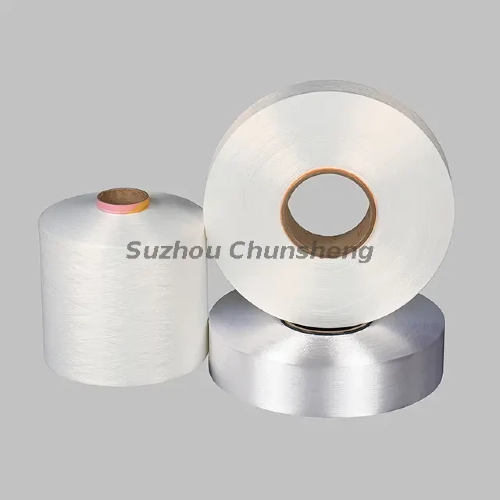
Mono yarn (monofilament yarn) is a textile yarn made from a single continuous filament rather than a bundle of many filaments. Because it behaves more like a “structural wire” than a soft bundle, mono yarn is widely used wherever fabrics must hold shape, keep mesh openings stable, resist abrasion, or maintain clean edges.
Textile designers choose mono yarn when they need:
Shape retention: fabrics keep a 3D form instead of collapsing.
Dimensional stability: less deformation after wear, washing, or heat.
Abrasion resistance: better durability at edges and high-friction points.
Clean appearance: very low fuzz/hairiness, so less linting and pilling.
Stable pore geometry: mesh holes stay consistent, which matters for breathability and filtration.
Controlled stiffness and spring-back: helps fabrics “snap back” to their intended structure.
This is the most common use case. Mono yarn helps mesh maintain open holes and avoid “bagging out” over time.
Typical products:
Sports footwear uppers (structured mesh zones)
Performance apparel ventilation panels
Backpack and running-vest meshes
Office and automotive seating mesh
Household meshes (laundry bags, storage mesh)
Designers use mono yarn as a stable framework to reduce distortion and keep patterns crisp.
Typical products:
Lace fabrics with defined motifs
Embroidery grounds where pattern stability matters
Sheer overlays that need structure without heavy weight
In tapes, webbings, and component textiles, mono yarn often functions as reinforcement.
Typical products:
Narrow tapes and binding
Zipper tapes and fastener structures
Reinforcement lines inside technical fabrics
Because mono yarn is predictable and stable, it’s common in technical structures where performance is measured.
Typical products:
Filter cloth and filter belts (stable pore sizes)
Conveyor textiles
Reinforcement scrims
Geotextiles and agricultural nets
| Property | Mono yarn | Multifilament yarn |
|---|---|---|
| Structure | Single filament | Many filaments bundled |
| Feel | Crisp/structured | Soft/drapey |
| Mesh hole stability | Excellent | Medium (depends on build) |
| Edge abrasion resistance | Often higher | Often lower (can fuzz/fray) |
| Visual cleanliness | Very clean (low fuzz) | Can be clean but may fuzz |
| Comfort next to skin | Depends on fineness | Usually better |
When specifying mono yarn, focus on:
Denier/dtex (thickness): thicker = more stiffness/durability; finer = softer feel and better comfort.
Diameter uniformity: crucial for consistent mesh appearance and performance.
Strength & elongation: important for reinforcement and industrial uses.
Shrinkage/heat stability: affects shape retention after heat-setting and washing.
Surface finish: controls friction, abrasion, and processing behavior.
Mono yarn is mainly used for mesh fabrics, structured lace bases, reinforcement elements, component textiles, and industrial fabrics like filtration and geotextiles—anywhere stability, shape, and abrasion resistance matter.
Because mono yarn helps keep mesh holes stable and prevents the fabric from collapsing or stretching out of shape after repeated wear and washing.
It can be. Fine-denier mono yarn and smart fabric zoning (using mono yarn only where structure is needed) can keep garments comfortable while still providing stability.
Yes, mono yarn can be made from recycled polymer feedstocks. The key is verifying consistent quality and performance for the intended end use.